
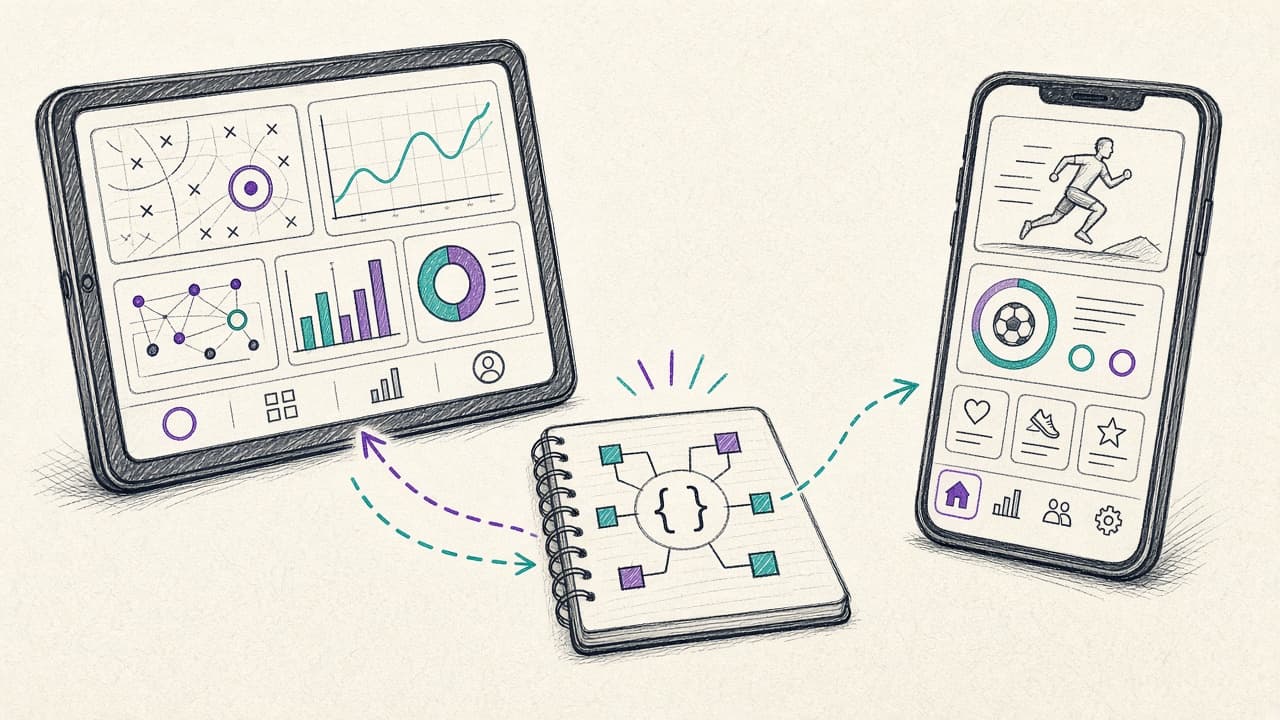
Many “multi-role” apps fail for a simple reason: they treat different users as the same person with different permissions. In sports performance software, that mistake is expensive. Coaches and players do not need the same screens with a few buttons hidden — they need different products that share a domain.
On Next11, WonderIT helped evolve a React Native system that serves both audiences: a coach experience centered on live sessions, team management, and load planning; and a player experience centered on personal progress, wellness, and clarity after training.
Why dual audiences change the architecture
A coach on a tablet is making operational decisions in real time: who looks overloaded, which tags are online, whether the Edge device is healthy, how the session should end, and what the weekly load implies for tomorrow.
A player on a phone is asking different questions: How hard was I pushed? Am I progressing? How do I feel? What does this mean for me?
Those jobs require different navigation models, different state priorities, and different emotional design. Shared components help. Shared assumptions hurt.
What we kept shared
- Domain language: sessions, load, intensity, wellness, benchmarks
- Backend and auth concepts through Firebase-backed identity and club context
- Design system building blocks where visual consistency strengthens the brand
- TypeScript models and converters that keep sports metrics consistent across surfaces
What we intentionally separated
- App entry and platform targeting — tablet-first coach workflows vs phone-first player workflows
- Navigation information architecture
- State stores oriented around each product’s daily jobs
- Feature depth: live Edge operations stay in the coach world; personal progression lives in the player world
Practical lesson: product boundaries beat clever abstractions
It is tempting to over-abstract “one sports shell.” In practice, the cleaner strategy is clear product seams with selective reuse. That keeps coach urgency from leaking into player calm, and keeps player simplicity from stripping coach power.
For teams building marketplace-style, B2B2C, or operator-plus-end-user products, this is often the difference between a scalable codebase and a permanent compromise.
Takeaways for product teams
- Map jobs-to-be-done per audience before sharing screens
- Share domain models more aggressively than UI trees
- Let platform realities (tablet vs phone) influence information density
- Protect live operational tools from being diluted by consumer-app patterns
Closing
Next11’s dual-app approach shows that React Native can support more than one product personality — if you design for that on purpose. WonderIT helps teams make those architecture calls early, before the wrong abstractions harden.
If you are building one mobile codebase for multiple user types, we can help you draw the right boundaries.